
Why serious no-code products become an AI-era dead end
Why hidden no-code logic blocks AI-assisted engineering and turns no-code lock-in into a modernization risk for serious products.
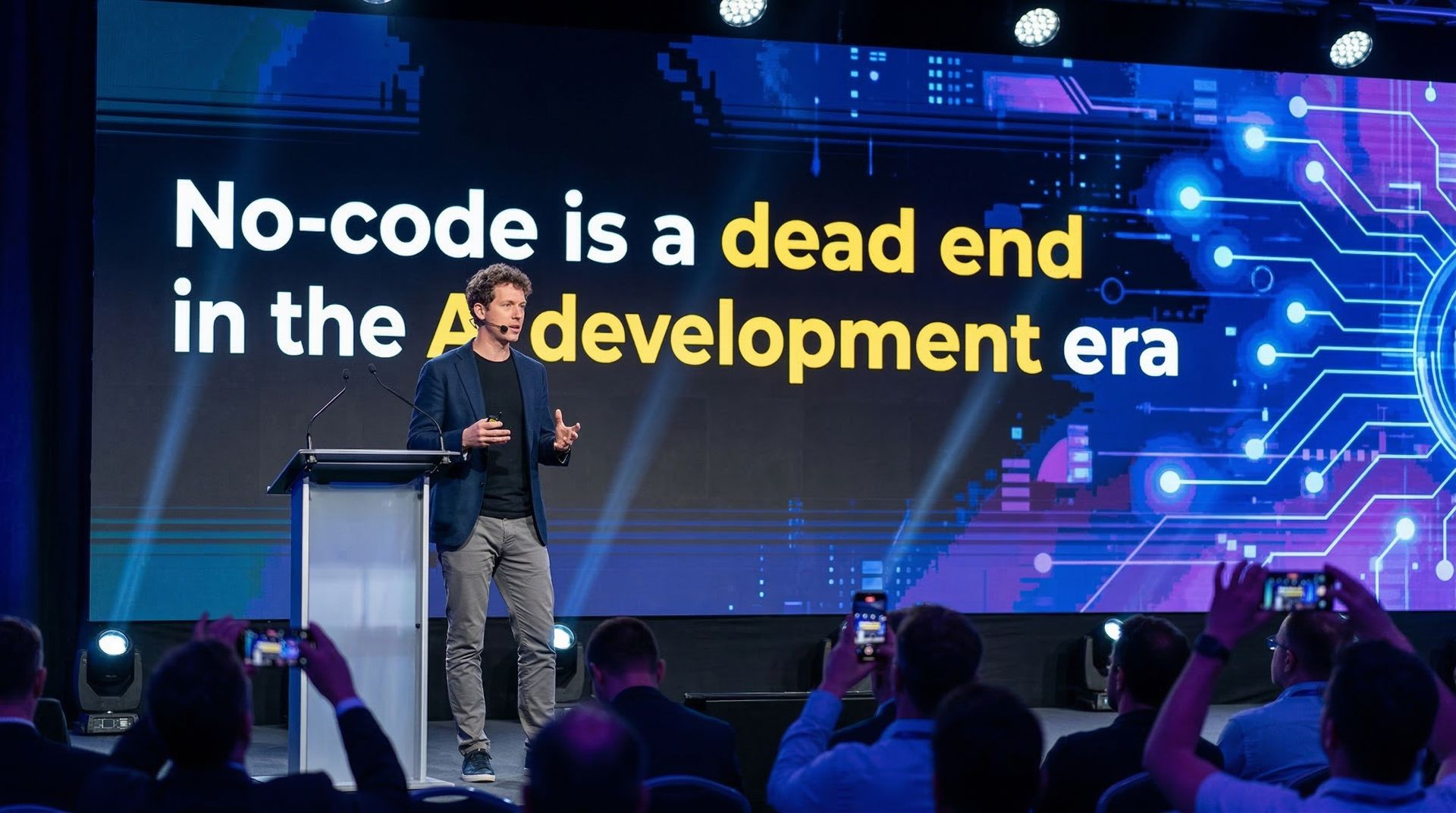
Why serious no-code products become an AI-era dead end
Plenty of Bubble products begin as a practical shortcut. A founder needs something working, a team needs proof of demand, and the visual builder gets the first version live. That is not the problem.
The problem starts later, when the app becomes business-critical and the company still cannot clearly explain how it works.
At that point the issue is no longer whether Bubble is fashionable. The issue is whether the product can be safely owned, improved, and handed to a serious engineering team. In the AI era, that gap gets more expensive, not less.
What lock-in looks like in practice
Most troubled Bubble apps do not fail because of one dramatic architectural mistake. They fail because critical logic is spread across visual workflows, one-off conditions, plugin behavior, and tribal memory.
That usually creates a familiar pattern:
- nobody has a reliable system map,
- changes feel risky because the logic chain is hard to inspect,
- integrations are partly understood and partly guessed,
- a contractor or former builder remains the only person who can explain the app,
- every future migration discussion starts from uncertainty instead of facts.
From the outside, the product may still look healthy. Internally, it becomes harder to trust.
Why the AI era makes this worse
Modern engineering teams are getting faster because more of their work is explicit. They have codebases, architecture documents, typed APIs, database schemas, tests, and tooling that AI can inspect and reason about.
That leverage depends on visibility.
Bubble hides much of the material that AI-assisted engineering needs. The business logic is not sitting in a normal codebase. The workflow structure is difficult to review at scale. The operational rules are often embedded in builder-specific patterns that do not translate cleanly into normal software delivery.
So while code-first teams gain speed from AI, Bubble-heavy teams often hit the opposite effect. They have more pressure to modernize, but they still do not have the explicit system view required to modernize safely.
When the product has outgrown the builder
There are a few clear signals that a Bubble product has moved out of the safe experimentation zone:
- the app supports revenue, operations, or customer delivery,
- new features are slower because nobody trusts the current logic,
- integrations are multiplying and each one raises the risk of side effects,
- the company wants a stronger internal engineering function,
- migration conversations keep happening, but nobody can scope them credibly.
When those signals are present, "just keep patching it" stops being a real strategy. The team is already paying a modernization tax. It is just paying it in confusion instead of in explicit engineering work.
What this means for a founder or tech lead
This is not an argument against no-code experimentation. It is an argument for recognizing when the system has become too important to remain undocumented and structurally opaque.
A serious team does not need instant certainty before moving away from Bubble. It needs a defensible understanding of the current system. Without that, every rebuild estimate is softer than it looks, and every migration promise is carrying hidden risk.
The practical first step
The safest first move is not a blind rebuild. It is making the current system explicit enough to evaluate properly.
That is the role of the Bubble Reconstruction Audit. Brainfab reverse engineers the current app into a usable system view: workflows, entities, integrations, risk notes, and a migration-ready interpretation of how the product actually works today.
Once that exists, the team can make a stronger next decision. Before that, it is still guessing.